

1·
1 year agoThe cheapest one I know of is about $8 a month, so it should be affordable, even on a tight budget.
I’m Hunter Perrin. I’m a software engineer.
I wrote an email service: https://port87.com/
I write free software: https://github.com/sciactive
The cheapest one I know of is about $8 a month, so it should be affordable, even on a tight budget.
You can buy a super cheap cloud VM and use a (self hosted) VPN so it can access your own PC and a reverse proxy to forward all incoming requests to your own PC behind your school’s network.
It’s arguable whether this would violate their policy, since you are technically hosting something, but not accessible on the internet from their IP. So if you wanna be safe, don’t do this, otherwise, that could help you get started.

If they tried to close source it, someone would just fork it.

Hitchhiker’s Guide to the Galaxy deserves a good adaptation, rather than that trash movie and that too short BBC series.
To a certain extent, processors that only partially work can be sold as a different model. For example, if AMD makes a bunch of 8 core processors, they might be sold as a number of different models based on what, if anything, is wrong with them. The best ones where everything works will be sold as the highest model. Then the ones that can’t achieve the highest clocks, but all the cores and the iGPU works will be sold as the next highest model. Then the ones where a couple cores are bad will be sold as 6 core models, and so on.
They’re made with, essentially, toggle jumpers that can be “cut” to disable different parts of the CPU (I think this is in the chip’s internal firmware and not an actual hardware cut). So two CPUs with the same SKU might have different internal cores that are enabled/disabled. The SKU is basically just a guarantee of how many cores it has, what frequency they will run at, same for iGPU cores, IO capability, and cache.
Obviously, this only applies to CPUs with compatible die sizes. That’s determined by the package it’s ultimately going to be mounted on.
It’s called binning, and it helps achieve higher yields by allowing you to sell more of the “defective” units. The more variations they have, the more they can get for each chip on average. Like if they have a SKU with 8 cores and 32 PCIe lanes, and a SKU with 6 cores and 24 PCIe lanes, then a chip where all 8 cores work, but only 30 of the PCIe lanes work, would have to be sold as the cheaper 6 core SKU. Adding another SKU with 8 cores and only 24 PCIe lanes, would let them price that same chip higher.
https://www.techspot.com/article/2039-chip-binning/
One of the coolest applications of this I’ve seen is the CPU AMD released recently which was literally a PS5 CPU with the graphics disabled (because it didn’t work, or didn’t work well enough to put in a PS5).
Yay Jellyfin! What an awesome app!
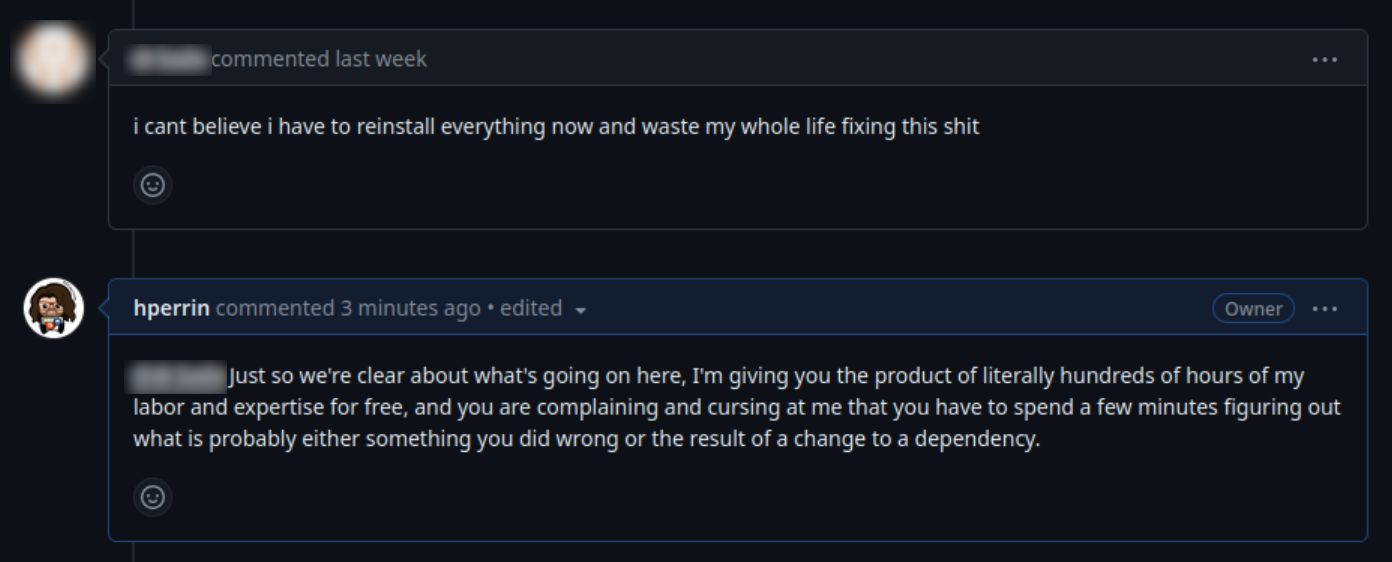
It is, until it isn’t. I’ve seen devs delete or abandon their projects because of too mush abuse. Nobody likes being yelled at. (Unless that’s your kink. I won’t judge.)
In this case, in trying to resolve the issue, he deleted his node_modules directory. So he’s talking about having to reinstall everything by typing npm install and waiting for it to finish.

Man, why are they still on Twitter? That place is toxic.


Turns out, when you give the felon the keys to the prison, they open it and let their friends out.