

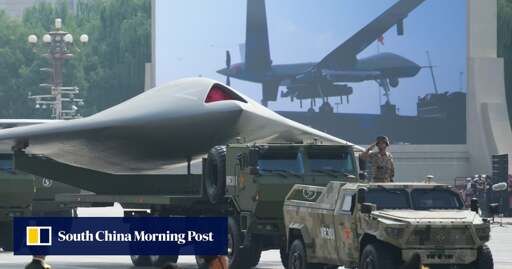
Scientists in China have demonstrated a wireless power transmission system that uses a ground-based microwave emitter to beam energy to an antenna array mounted on the aircraft’s underside. Importantly, they were able to do this while both the drone and charging system were in motion.
In tests, the car-mounted system kept fixed-wing drones in the air for up to 3.1 hours at an altitude of 15 metres (49 feet). The key challenge that the team overcame was maintaining alignment between the emitter and the drone during flight, wrote Song Liwei, the project’s leader.
A concentrated, collimated beam doesn’t act like a point source. There’s of course some amount of scattering and absorption loss due to atmospheric particles, but other than that a fully collimated wireless energy transmission doesn’t lose intensity over distance. Kind of obvious, really, because “where would the energy go?”.
We already have concentrated microwave beams. And they do suffer immense energy loss on longer distances.
If you want to transfer energy via microwaves, your efficency will reach single digits real fast on any meaningful distance.
You are right that the inverse square law doesn’t realistically apply with concentrated beams. But you still have energy loss. Lots of it.
But don’t take my word for it. https://www.nature.com/articles/s41598-022-25251-w
Quickly glancing through the paper it doesn’t really seem to support your claim. They attribute their major losses to the parabolic reflector (meaning they don’t have very well concentrated microwave beams?), and say that developing higher efficiency focusing components is important work for the future. I’m kind of guessing that’s one thing the Chinese are doing.
Still, I’m sure there are relevant losses even in properly focused microwave beams. How much that is, I have no clue, and didn’t see it addressed in the paper. Might have missed it - it was a very quick glance. :)
I’ll be honest, I didn’t exactly proof read every word either.
I think what they meant with parabolic reflector is the reciever. They mentioned they 3d printed a reciever to achieve recors breaking efficency (short range). It’s not so easy to gather and convert the microwaves into electric energy. And it’s probably not very easy to create a concentrated beam either.
But that was my interpretation. I’m not going to pretend I understand everything about this. I could be wrong.
I think the technology to have satellites charge drones in the sky is at least 50 years away.